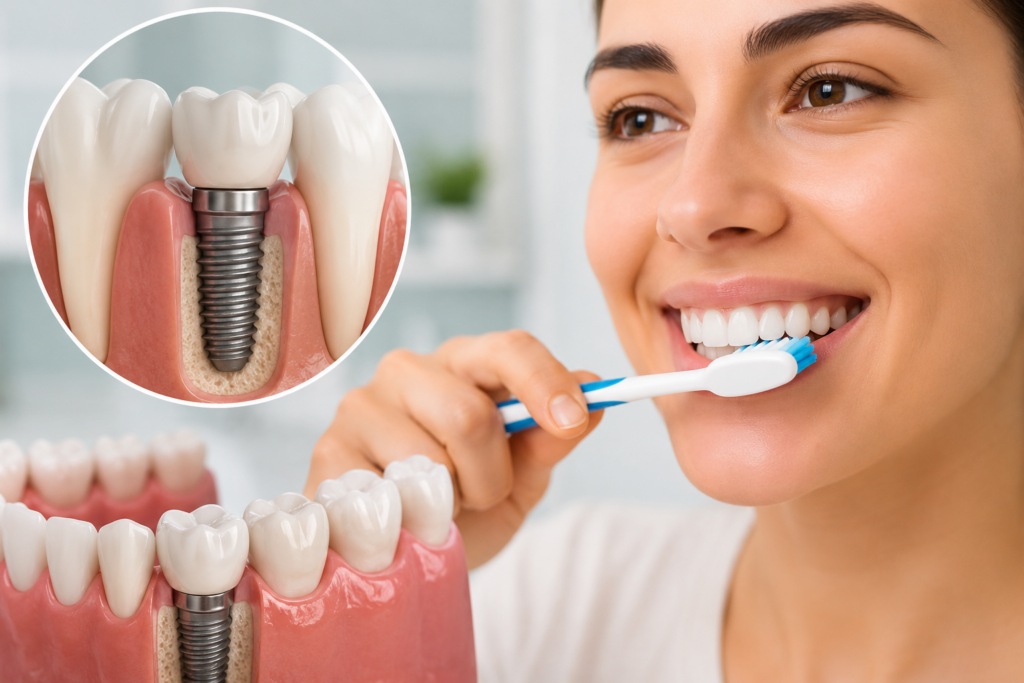
Brushing dental implants is completely safe, but the technique matters. Hard or medium bristles, abrasive whitening pastes, and aggressive horizontal scrubbing can damage the implant surface, irritate surrounding tissue, and accelerate gum recession around the implant collar. The clinical standard is simple: a soft-bristled brush, non-abrasive fluoride toothpaste, and a gentle angled stroke.
According to Dr. Namratha Chandrahari, Implantologist in Banjara Hills, require the same daily cleaning discipline as natural teeth but with technique modifications that protect the titanium-gum interface. “Peri-implantitis is almost always a hygiene failure, and it starts at the gum line where most patients brush too hard or skip entirely.”
Noticing bleeding or sensitivity around your implant while brushing?
Book AppointmentHow Should You Brush Dental Implants Differently From Natural Teeth?
Implants don’t have a periodontal ligament the way natural teeth do, so the surrounding soft tissue is the only biological seal protecting the implant fixture from bacterial infiltration.
- Bristle type: A soft or extra-soft bristled toothbrush is non-negotiable for implants, because medium or hard bristles abrade the gum margin and can scratch the implant crown surface in ways that accelerate plaque accumulation over time.
- Brush angle: Positioning the brush at a 45-degree angle to the gum line and using short circular strokes cleans the sulcus around the implant collar effectively, which is where biofilm builds up fastest and where peri-implantitis typically begins.
- Paste choice: Whitening toothpastes and baking soda-based formulas contain abrasive particles that scratch implant crown surfaces, so a low-RDA non-abrasive fluoride paste is the correct choice regardless of how the rest of the natural dentition is cleaned.
- Frequency: Brushing twice daily is the minimum, but implant patients with full arch restorations or bridges benefit from brushing after every meal since food trapping under the prosthesis is more common than with natural teeth.
Consistent brushing technique is what separates a 20-year implant from one that develops peri-implant bone loss within five years. Learn more about implant restorations that require specific hygiene protocols: permanent teeth.
What Else Do You Need to Clean Around Dental Implants Beyond Brushing?
Brushing alone doesn’t clean the interproximal spaces or beneath implant bridges, and those are exactly the areas where peri-implant disease tends to start.
- Interdental brushes: These are more effective than floss for cleaning around implant abutments and under implant-supported bridges because they can navigate the contoured surfaces of the prosthetic components that standard floss can’t reach or clean adequately.
- Water flossers: A water flosser used at low to medium pressure can flush debris and bacteria from beneath full-arch prostheses like All on 4 implants where conventional cleaning tools simply don’t access the tissue surface underneath.
- Implant floss: Specialty implant floss, also called super floss or implant-specific threaders, allows patients with single implants or three-unit bridges to clean beneath the pontic and around the abutment margin where routine floss can’t thread through unassisted.
- Professional cleaning: Implants need professional cleaning at least every six months using plastic or titanium-compatible instruments, since standard metal scalers can scratch the implant surface and compromise the seal between the crown margin and peri-implant tissue.
Good cleaning habits around implants aren’t optional. They’re what protects the bone level that holds the implant in place for decades.Read more: Full Mouth Dental Implants in Banjara Hills.
Why Choose Dr. Namratha Chandrahari?
Dr. Namratha Chandrahari, MDS, MFD RCSI (Ireland), MFDS RCPS (Glasgow), MICOI (USA), is a Prosthodontist and Implantologist with over 12 years of experience placing and restoring dental implants across single tooth, full arch, and complex full-mouth rehabilitation cases. Because she designs both the implant plan and the final prosthesis, every restoration is built with long-term hygiene access in mind, not just aesthetics.
Patients receive specific post-operative cleaning instructions based on the type of implant restoration they have, whether that’s a single crown, a bridge, or a full-arch fixed prosthesis. That level of detail in aftercare is what keeps implants functional well past the 15-year mark.
Yes, a soft-bristled electric brush on a gentle mode is safe and effective for implants.
Avoid whitening, charcoal, and baking soda-based pastes as they scratch implant surfaces.
Gentle brushing resumes after 24 hours, avoiding the surgical site until cleared by your dentist.
Consistent brushing and interdental cleaning significantly reduce the risk of peri-implantitis.
References
- National Institute of Dental and Craniofacial Research (NIDCR): https://www.nidcr.nih.gov/
- PubMed, Peri-implant disease and oral hygiene: https://pubmed.ncbi.nlm.nih.gov/
Disclaimer
This content is for informational purposes only and does not constitute medical advice. Please consult a qualified dental professional for personalised diagnosis and treatment recommendations.