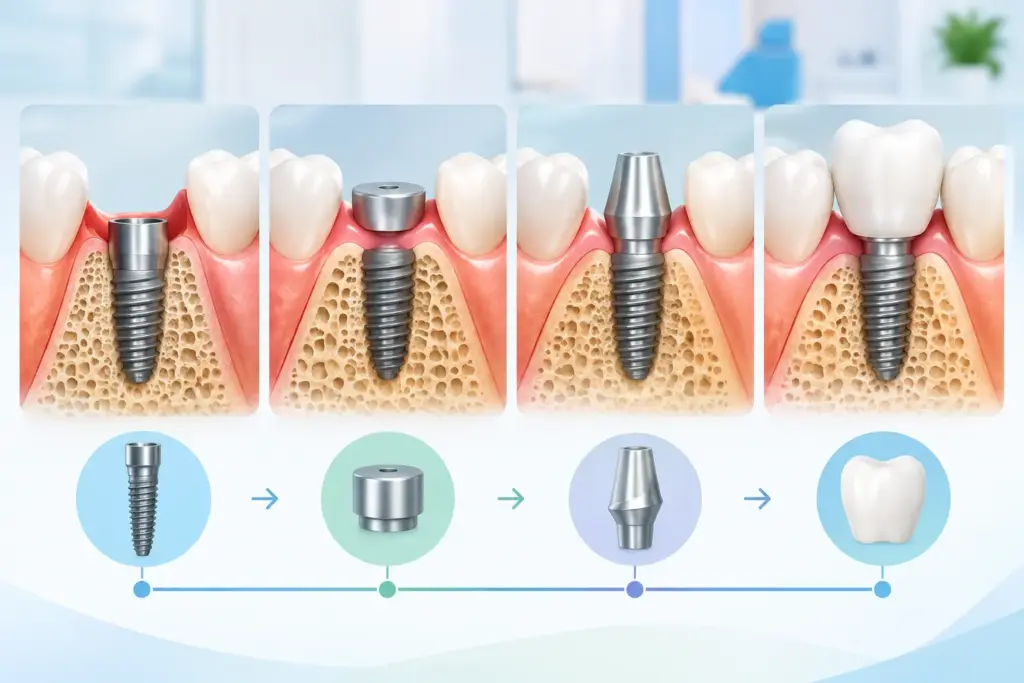
Basal implants need 3 to 5 days for the initial fixed prosthesis and 3 to 6 months for complete bone integration, though functional healing allowing normal biting happens sooner. Timeline depends on bone density, number of implants, and how well the site is protected during early loading.
According to Dr. Namratha Chandrahari, Implantologist in Banjara Hills, “Basal implants get their early strength from cortical bone, so patients function on their new teeth within days, but the bone underneath still needs months to mature fully around the implant surface.”
Not sure if your bone density supports a faster basal implant timeline?
Book AppointmentWhat Happens During the Basal Implant Healing Timeline?
Healing after basal implant placement moves through a few distinct phases, and each one has its own job to do.
First Week: Swelling and mild discomfort usually peak around day two or three and then ease off on their own, and the provisional bridge placed at surgery lets you chew soft foods almost right away.
Month One: Soft tissue around the implant collar closes up and stabilizes, though the bone underneath is still in an early, fragile stage of fusing with the implant surface.
Months 2 to 4: Secondary stability builds as new bone lays down along the basal plates, and honestly, this stretch is where patience matters most because nothing looks dramatic from the outside.
Month 6: Full osseointegration is usually confirmed around this point, and permanent zirconia crowns get finalized once the implant shows zero mobility on clinical checks.
Because basal implants anchor in denser cortical bone instead of the softer bone above it, the healing curve looks different from conventional implants and moves faster in that first critical phase. This immediate-loading approach is similar to what’s used for immediate implants, where a provisional bridge restores function starting day one.
What Affects How Fast Basal Implants Heal?
A handful of clinical factors speed up or slow down this window, and most of them are within a patient’s control.
Bone Quality: Denser cortical bone gives the implant its early grip, which is exactly why basal implants work well as one of the implants without bone graft options for patients who lack volume in the upper jaw.
Oral Hygiene: Plaque control around the provisional bridge in month one has an outsized effect on outcomes, and skipping this step is probably the single biggest reason healing gets delayed.
Loading Forces: Early overloading from hard or sticky foods can micro-move the implant before bone has locked in, undoing weeks of progress in a single bad bite.
Medical Factors: Uncontrolled diabetes, smoking, and certain medications slow bone metabolism, so these need flagging and managing before surgery, not after.
Most delays trace back to loading forces or hygiene lapses rather than the implant system itself. That’s why the maintenance routine in the first three months matters nearly as much as the surgery. A closer look at what to eat and avoid during this window is covered in this guide on foods to avoid after implant surgery.
Why Choose Dr. Namratha Chandrahari?
Dr. Namratha Chandrahari is a Prosthodontist and Implantologist trained in the UK, certified by ICOI USA, and Nobel Biocare certified in zygomatic implants, with over 12 years planning complex full-mouth and basal implant cases. Every basal case is planned on a CBCT scan first, so the healing timeline given to a patient reflects their actual bone, not a generic average.
Patients who healed poorly elsewhere due to loading too early are routinely stabilized and get final crowns on a revised, realistic timeline without starting the surgery over. Most healing setbacks come down to timing, not the implant itself.
Soft foods only for the first week, then gradual progression.
No, they anchor in existing basal bone, avoiding grafts.
No mobility, no persistent pain or swelling by week three.
Yes, it slows bone healing and raises early failure risk.
References
- Patel K, et al. Basal Implants: An Asset for Rehabilitation of Atrophied Resorbed Maxillary and Mandibular Jaw. National Center for Biotechnology Information.
- Ghalaut P, et al. Full-mouth rehabilitation with immediate loading basal implants. National Center for Biotechnology Information.
Disclaimer
This content is for informational purposes only and does not constitute medical advice. Please consult a qualified dental professional for personalised diagnosis and treatment recommendations.