
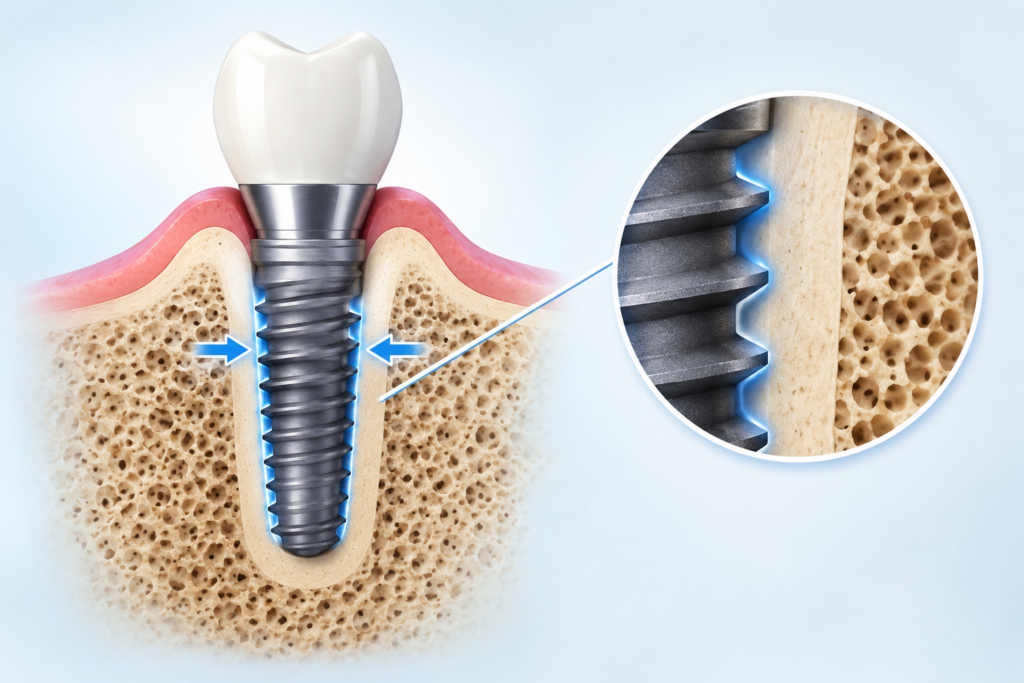
Bicortical stability is the fixation of a basal implant in two layers of dense cortical bone, which gives it firm primary stability at placement. Basal implants anchor in the strong basal bone of the jaw rather than the softer alveolar bone around tooth roots. That anchorage allows early loading, resists chewing forces, and suits jaws with low bone volume.
According to Dr. Namratha Chandrahari, Implantologist in Banjara Hills, “A basal implant earns its stability from cortical bone at two points, so I confirm that grip on the CBCT scan before planning anything else.”
Worried your jawbone is too thin for an implant?
Book AppointmentHow Does Bicortical Stability Work in Basal Implants?
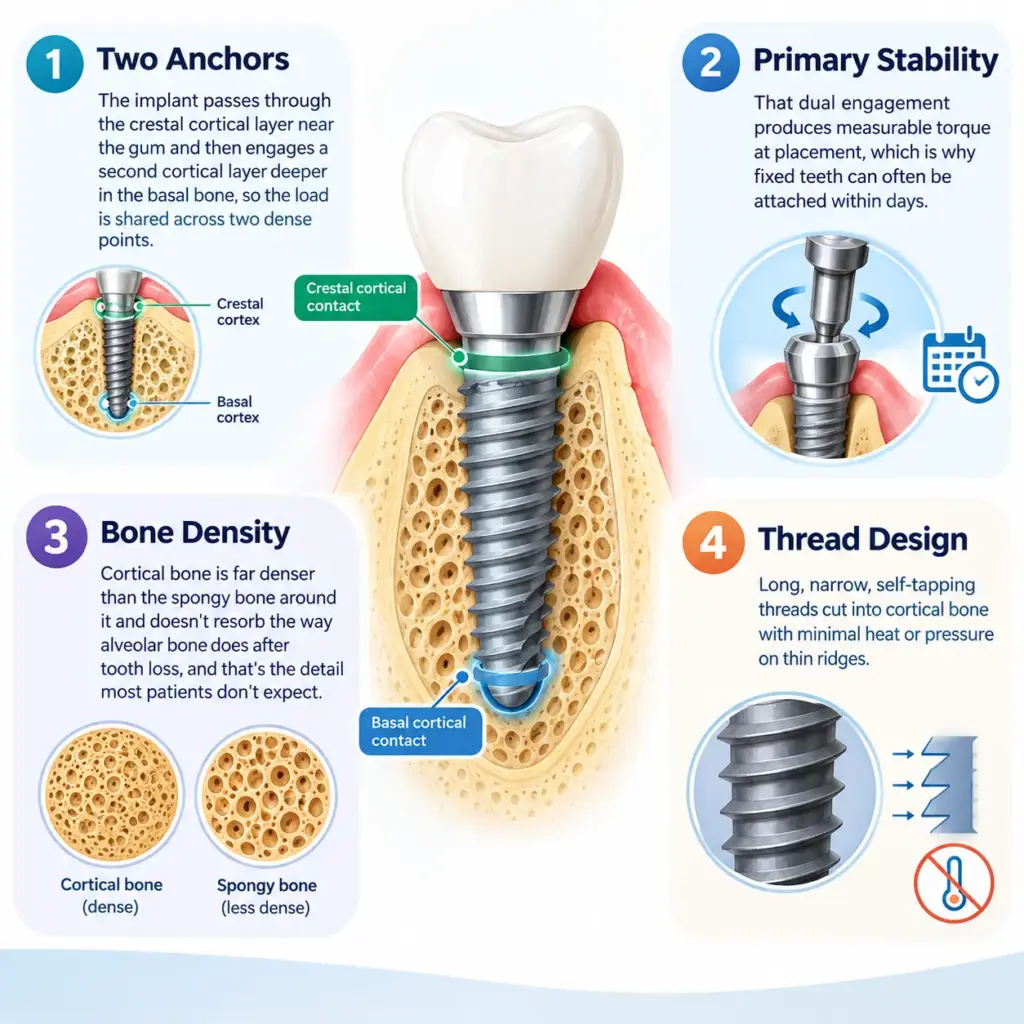
Because anchorage sits in dense basal bone, patients with thin ridges can often be treated with implants without bone graft, since density matters more than height.
Why Does Bicortical Stability Matter for Long-Term Implant Success?
Primary stability at placement strongly influences whether an implant integrates or fails.
- Immediate Loading: Firm cortical grip makes fixed teeth within days possible, because the implant can carry bite forces before healing is complete.
- Micromotion: Movement beyond about 150 microns at the bone interface can disrupt healing, but bicortical fixation keeps the implant still enough to integrate.
- Severe Bone Loss: In advanced resorption, basal anchorage or pterygoid implants placed at the back of the upper jaw can still deliver a fixed result.
- Long-Term Load: Dense cortical bone absorbs the constant stress of chewing, so the implant is less likely to loosen over the years.
Stability at placement doesn’t replace hygiene or follow-up, but it gives integration its best start, and the guide to permanent teeth replacement covers the wider options.
Why Choose Dr. Namratha Chandrahari?
Dr. Namratha Chandrahari, MDS, MFD RCSI (Ireland), MFDS RCPS (Glasgow), MICOI (USA), is a prosthodontist and implantologist with over 12 years of experience in full mouth rehabilitation and complex implant cases. She’s also Nobel Biocare certified in zygomatic implants.
Patients with low bone volume are planned on CBCT scans, treated by the same specialist who designs the final teeth, and followed until healing is confirmed. Many leave with fixed teeth in 3 to 5 days. No guesswork, no unnecessary grafting
Implants anchored in the dense basal bone of the jaw instead of the alveolar bone.
It means the implant engages two separate layers of cortical bone for fixation.
Yes, in suitable cases, fixed teeth can be placed within days of surgery.
Patients with low bone volume or long-term tooth loss who want to avoid grafting.
References
- Rapid Smile Restoration: Basal Implants for the Edentulous Mandible With Immediate Loading
- Conventional and Basal Implantology: A Narrative Review of Current Evidence, Clinical Decision-Making, and Future Perspectives
Disclaimer
This content is for informational purposes only and does not constitute medical advice. Please consult a qualified dental professional for personalised diagnosis and treatment recommendations.