
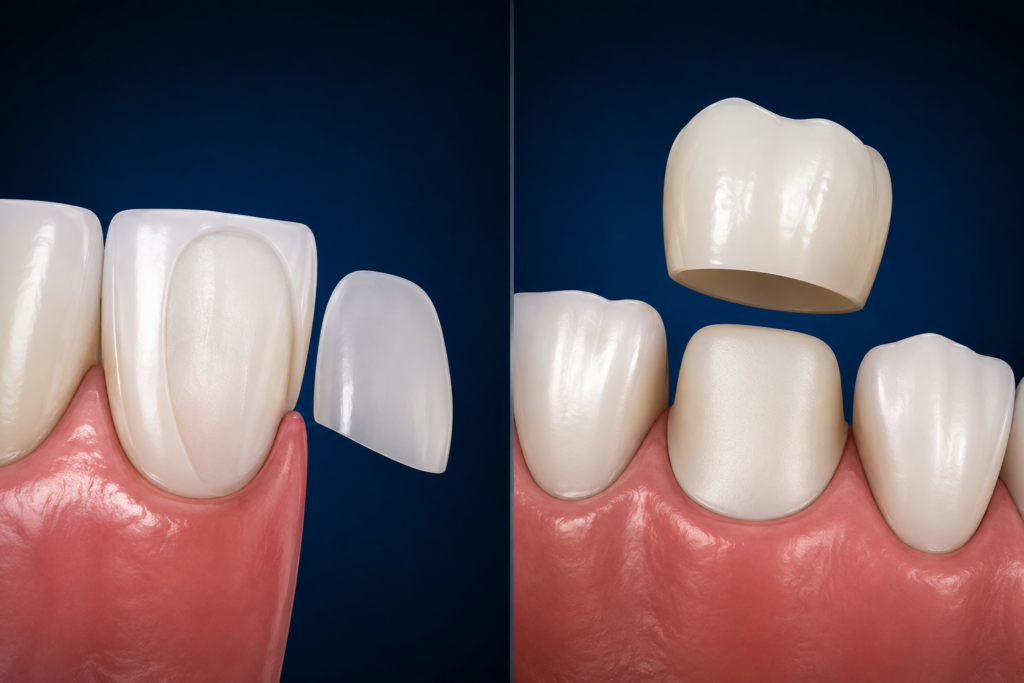
Porcelain veneers and zirconia crowns solve different dental problems. Veneers are a cosmetic shell that covers only the front face of a tooth, while zirconia crowns encase the entire tooth and restore both function and appearance. Veneers suit teeth that are structurally sound but cosmetically imperfect. Crowns are the clinical choice when a tooth is cracked, heavily decayed, or implant-supported.
According to Dr. Namratha Chandrahari,a leading Implantologist in Banjara Hills planning starts with the structural condition of the tooth “a veneer placed on a compromised tooth will fail, so the crown vs veneer decision is clinical before it’s cosmetic.”
Confused about which restoration fits your specific tooth condition?
Book AppointmentWhat Are the Key Differences Between Porcelain Veneers and Zirconia Crowns?
The choice between veneers and crowns depends on how much of the tooth structure is damaged and what clinical outcome the patient needs.
- Coverage: A veneer bonds to the front enamel surface only, leaving the rest of the tooth untouched, while a zirconia crown wraps the entire tooth from all sides and protects the underlying structure completely.
- Tooth prep: Veneers need only a thin layer of enamel removed, typically under 0.7 mm, whereas crowns require reduction on all sides, which is a more involved preparation but also a more protective end result.
- Load bearing: Zirconia’s fracture resistance is significantly higher than porcelain, so for molars and premolars under heavy chewing force, crowns deliver better long-term stability than veneers could.
- Implants: Veneers don’t bond to implant abutments at all. That’s where zirconia crowns are the standard, since they’re cemented or screwed onto the implant with a precise fit designed to handle occlusal load.
Both restorations require healthy gum tissue and should be placed only after any underlying decay or periodontal issues have been treated. Zirconia crowns are particularly recommended when a tooth has undergone root canal treatment, since that tooth loses moisture and becomes brittle over time.
When Should You Choose Porcelain Veneers Over Zirconia Crowns?
Veneers are the right call for patients whose teeth are structurally healthy but have surface-level cosmetic concerns that affect their smile.
- Staining: Intrinsic discoloration that doesn’t respond to whitening, caused by tetracycline, fluorosis, or trauma, is one of the most common and valid indications for porcelain veneers, since they provide a permanent colour correction without full crown preparation.
- Minor chips: A chipped front tooth with an intact core and sufficient enamel can be precisely restored with a veneer that matches adjacent teeth in translucency and contour without cutting down the whole tooth.
- Gaps: Diastemas and mild spacing issues between front teeth are routinely corrected with porcelain veneers when orthodontic treatment isn’t the patient’s preference. The veneer is shaped slightly wider to close the visible gap.
- Shape correction: Peg laterals, undersized teeth, or worn incisal edges can all be built up and reshaped with veneers while preserving the majority of natural tooth structure, a meaningful advantage for younger patients.
So veneers aren’t just about aesthetics for vanity’s sake. They’re a precise, minimally invasive solution for specific cosmetic diagnoses. read more: Smile Makeover in Banjara Hills.
Why Choose Dr. Namratha Chandrahari?
Dr. Namratha Chandrahari, MDS, MFD RCSI (Ireland), MFDS RCPS (Glasgow), MICOI (USA), is a dual-qualified Prosthodontist and Implantologist with over 12 years of experience in smile reconstruction, crown restorations, and full-mouth rehabilitation. Her prosthodontic specialty means she designs and places both the restoration and the underlying structure, a distinction that directly affects how veneers and crowns fit, function, and last.
Patients don’t get generic treatment plans here. Cases involving damaged teeth, post-root canal crowns, smile makeovers, and implant-supported restorations are evaluated clinically before any material or technique is decided. That’s a different approach from cosmetic-first dentistry, and the outcomes reflect it.
Not recommended. A root canal treated tooth needs a crown for structural protection.
Zirconia crowns typically last 15 to 20 years or more; porcelain veneers last 10 to 15 years.
Only for mild cases. Significant misalignment requires orthodontic correction first.
Yes, modern zirconia is highly translucent and matches natural tooth appearance well.
References
- National Institute of Dental and Craniofacial Research (NIDCR): https://www.nidcr.nih.gov/
- PubMed, Clinical performance of zirconia-based crowns:
https://pubmed.ncbi.nlm.nih.gov/
Disclaimer
This content is for informational purposes only and does not constitute medical advice. Please consult a qualified dental professional for personalised diagnosis and treatment recommendations.